
Currently Empty: 0.00$
Learning
A Complete Guide to Places of Articulation
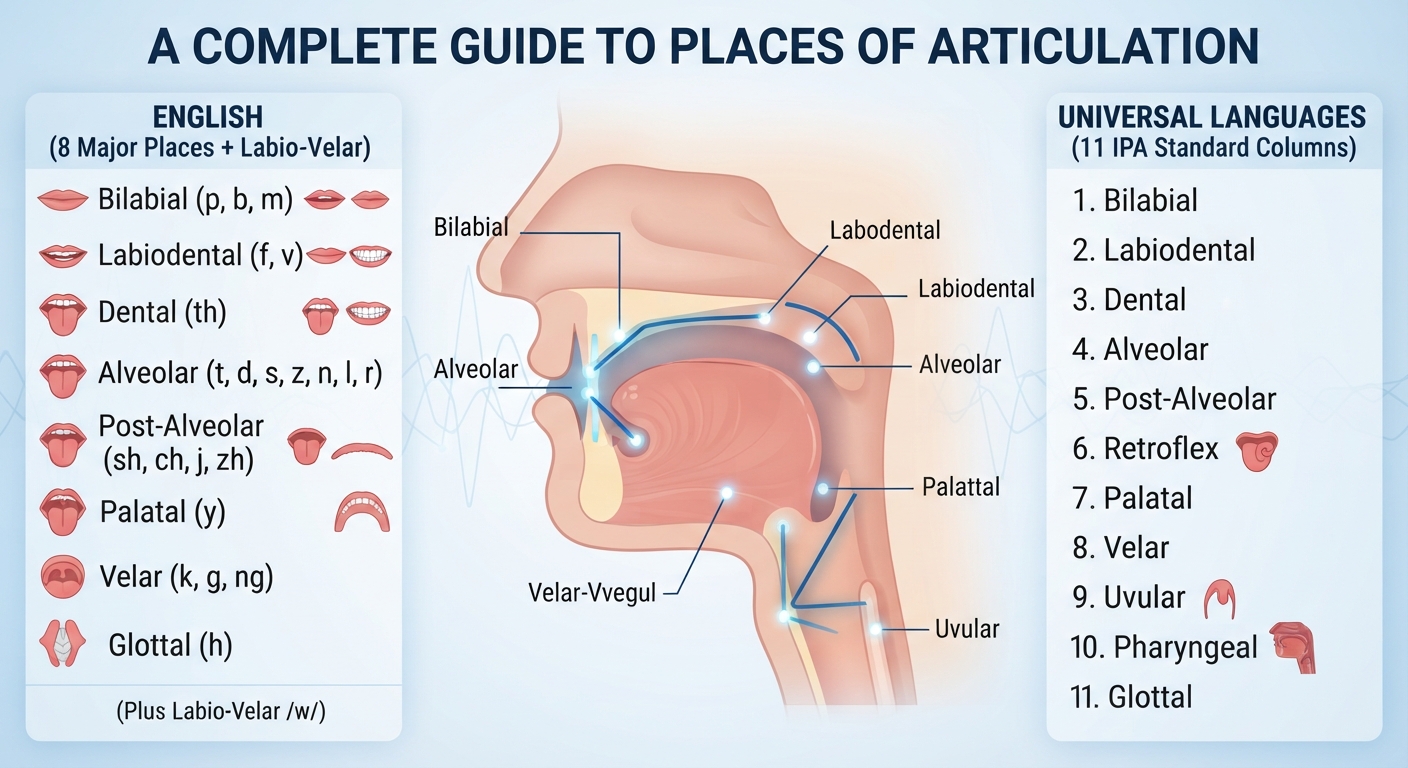
The number of places of articulation depends on whether you are looking specifically at English or at human language across the world (the International Phonetic Alphabet): in A Complete Guide to Places of Articulation, linguists examine how sound is produced using the vocal tract’s various articulators.
-
In English: There are 8 main places of articulation (9 if including labio-velar).
- In World Languages (IPA): There are 11 major standard places of articulation on the official International Phonetic Alphabet chart.
1. English Places of Articulation (8 Major Places)
English uses 8 primary locations in the vocal tract to make consonant sounds:
- Bilabial: Both lips come together (p, b, m)
-
Labiodental: Lower lip + upper teeth (f, v)
-
Dental: Tongue + upper teeth (th in think/this)
-
Alveolar: Tongue + ridge behind front teeth (t, d, s, z, n, l, r)
-
Post-Alveolar: Tongue + just behind the alveolar ridge (sh, ch, j, zh)
-
Palatal: Tongue body + hard roof of mouth (y in yes)
-
Velar: Back of tongue + soft palate (k, g, ng)
-
Glottal: Throat/vocal cords (h)
(Note: English also uses Labio-Velar for /w/, which is a double/combined articulation using both the lips and soft palate).
2. Universal Places of Articulation (11 Standard IPA Columns)
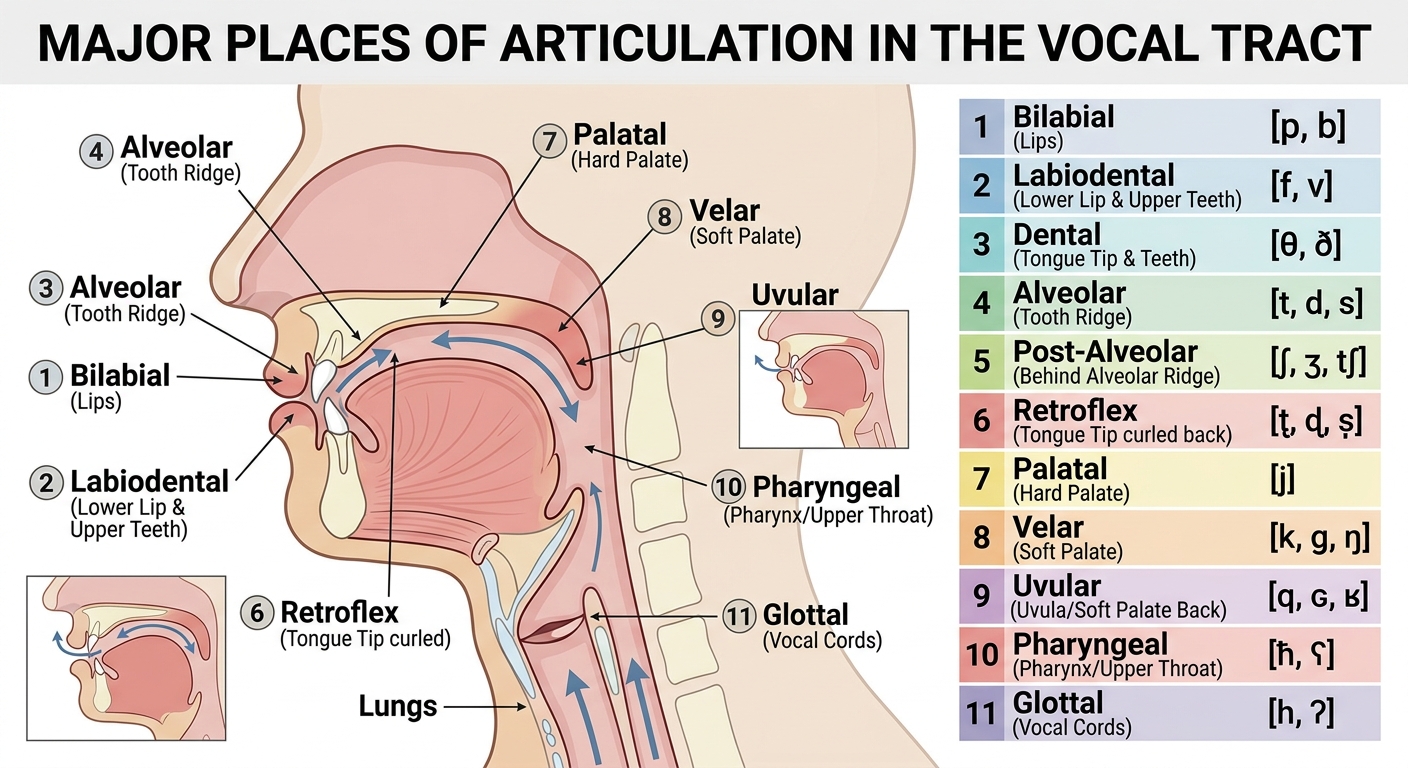
Across all spoken languages globally, the International Phonetic Alphabet defines 11 standard places, arranged from the front of the mouth to the back of the throat:
-
Bilabial (lips)
-
Labiodental (lips & teeth)
-
Dental (teeth)
-
Alveolar (tooth ridge)
-
Post-Alveolar (behind tooth ridge)
-
Retroflex (tongue curled back)
-
Palatal (hard palate)
-
Velar (soft palate)
-
Uvular (back soft palate / hanging uvula)
-
Pharyngeal (deep throat / pharynx)
-
Glottal (vocal cords)