

Currently Empty: 0.00$
Uncategorized
The Importance of Letter Formation in Early Childhood Education
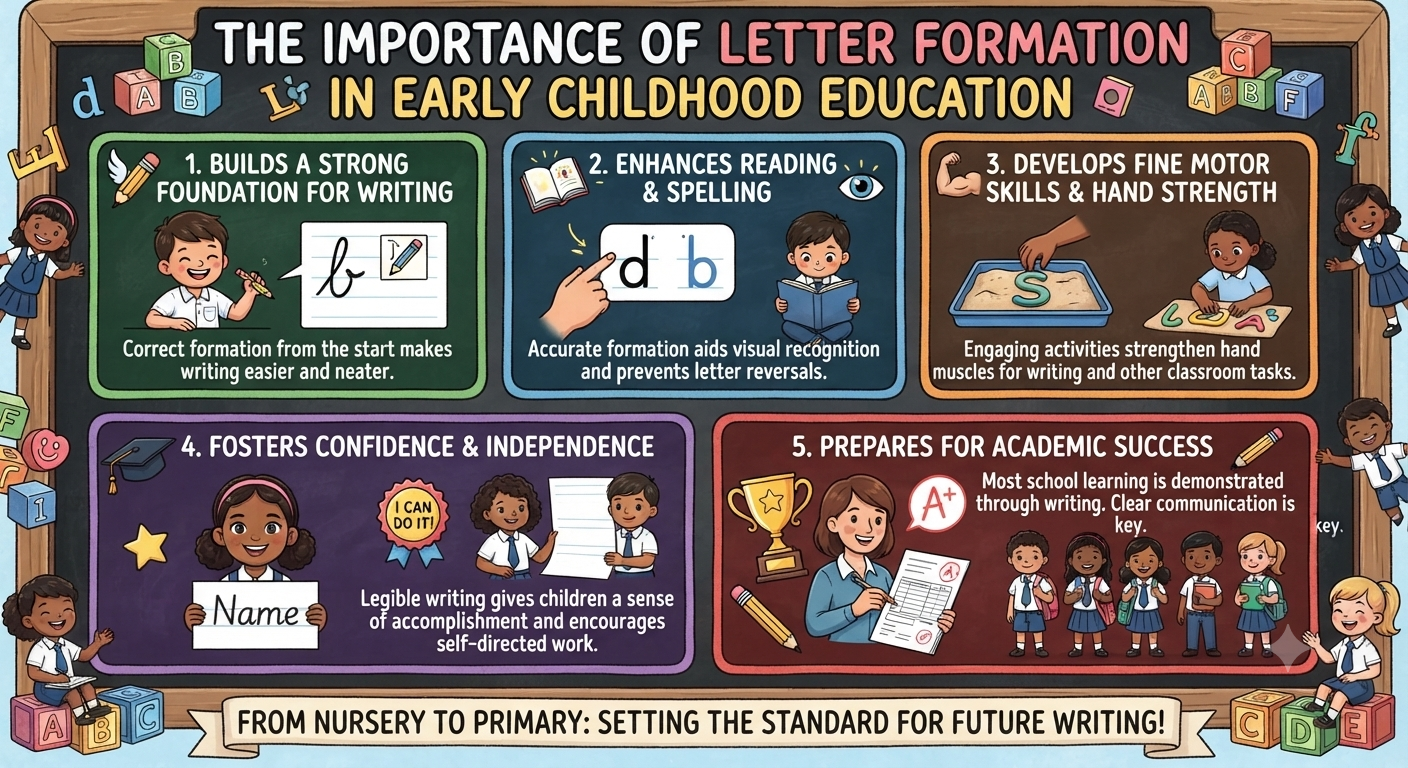
The early years of education, from Nursery to Lower Primary, lay the foundation for future learning. During this period, children do more than learn the alphabet; they begin to form letters, a skill essential for written communication. Letter formation, the correct method of writing each letter from start to finish, may seem minor, but it is one of the most important skills learned in early childhood.
Correct Letter Formation Builds a Strong Foundation for Writing:
Writing is a skill that children use every day in school and in life. If a child learns the wrong way to form letters from the beginning, it becomes very difficult to correct later. For example, a child who learns to form “b” with a straight line down and a curve around will find writing easier, faster, and neater. Good letter formation from Nursery and Reception sets the standard for future writing.
Correct letter formation also enhances reading and spelling skills:
Reading and writing are interconnected cognitive processes. When children learn to form letters accurately, they are better able to recognise them visually. The coordination between hand and eye is strengthened, reducing the likelihood of confusing similar letters such as “d” and “b” during reading.
Letter formation contributes to the development of fine motor skills and hand strength:
The process involves not only cognitive engagement but also the use of hand and finger muscles. Tracing, copying, and writing letters strengthen the muscles required for tasks such as holding a pencil, using scissors, and performing other classroom activities. Engaging in activities such as forming letters in sand, playdough, or paint before using a pencil further supports the development of hand strength in young children.
Mastery of letter formation fosters confidence and independence in young learners:
Children experience a sense of accomplishment when they can write their names legibly. Proficient letter formation encourages them to engage independently in activities such as labelling drawings, writing on the board, and completing worksheets.
Proficient letter formation prepares children for academic success:
The majority of school-based learning, from spelling tests to examinations, is demonstrated through writing. Teachers must be able to read students’ work to accurately assess understanding. If a child’s writing is illegible due to poor letter formation, their knowledge may not be recognised. Correct letter formation ensures that students’ ideas are effectively communicated.
Prevents bad habits that are hard to break:
It is much easier to teach a child the right way the first time than to reteach and unteach later. Poor habits such as starting letters in the wrong place, using the wrong pencil grip, or inconsistent sizing often begin in the early years. A child who always forms “e” backwards in Nursery will carry that habit to Primary 3 unless it is corrected early. Teaching correct formation from the start saves time and prevents frustration for both the child and the teacher.
In conclusion, letter formation in the early years extends beyond aesthetics; it establishes the physical, cognitive, and emotional foundations necessary for literacy. Children who learn correct letter formation demonstrate improved reading, faster writing, and greater confidence. It is essential for parents and teachers to provide ample opportunities for Nursery and Reception children to engage with letters through tracing, moulding, painting, and guided practice.
Master Grammar Fundamentals
Whether you are teaching kindergarteners or refining your own skills, this course provides a clear blueprint and interactive tools to make grammar effortless.
Core Skills:
- Basics: Master the alphabet, vowels, and consonants.
- Grammar: Learn nouns, pronouns, adjectives, verbs, and prepositions.
- Writing: Gain expertise in sentence structure, word order, and punctuation.
🎓 Bonus: Receive a completion certificate upon finishing the course.