

Currently Empty: 0.00$
Child Development
Why Early Grammar Matters
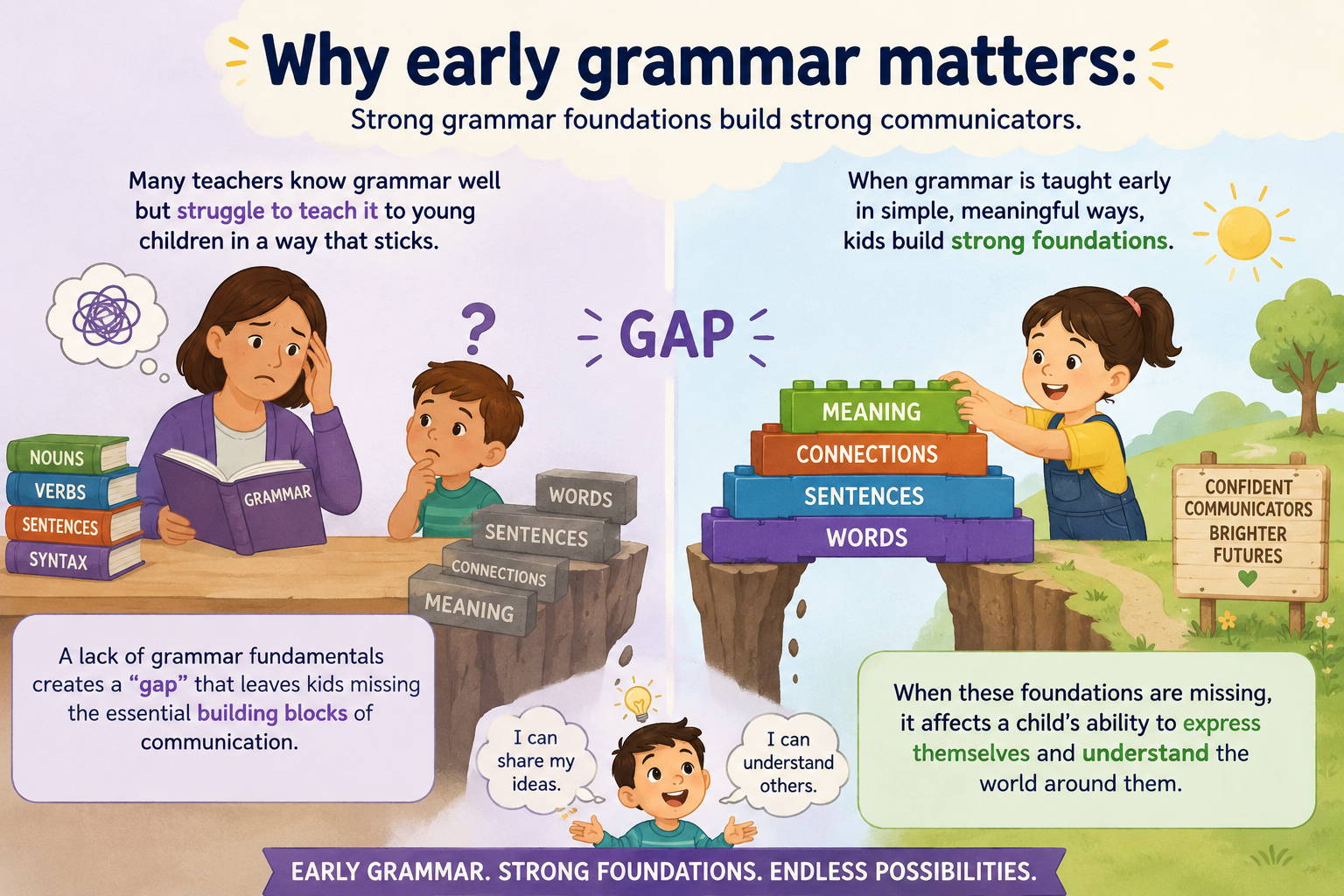
Why Early Grammar Matters: Many teachers know grammar well but struggle to teach it to young children in a way that sticks. A lack of grammar fundamentals creates a “gap” that leaves kids missing the essential building blocks of communication. When these foundations are missing, it affects a child’s ability to express themselves and understand the world around them.
What happens when kids miss out?
- Confusing Speech: They struggle to explain ideas clearly.
- Reading Struggles: They find it hard to understand how words fit together to tell a story.
- Weak Foundation: Future schoolwork becomes much harder without these basics.
Simple Ways to Teach Grammar
We can teach “big” concepts using fun, hands-on methods:
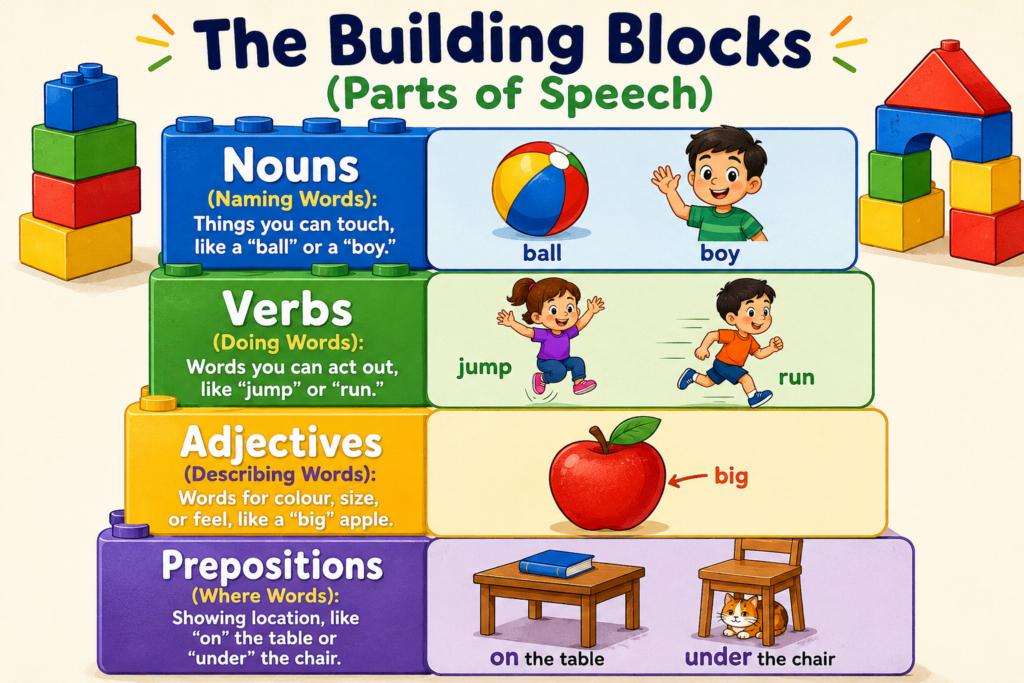
1. The Building Blocks (Parts of Speech)
- Nouns (Naming Words): Things you can touch, like a “ball” or a “boy.”
- Verbs (Doing Words): Words you can act out, like “jump” or “run.”
- Adjectives (Describing Words): Words for colour, size, or feel, like a “big” apple.
- Prepositions (Where Words): Showing location, like “on” the table or “under” the chair.
2. Making Sentences
- Full Ideas: Teaching kids that a sentence needs a “who” and an “action” (e.g., “The cat sleeps”).
- Speaking in Sentences: Encouraging kids to talk in full thoughts rather than just one-word answers.
3. Writing Basics
- Start & Stop: Using capital letters to start and periods (.), question marks (?), or exclamation marks (!) to finish.
- One or Many: Learning that adding an “-s” changes a “book” into “books.”
How Training Helps
When teachers learn how to simplify these lessons, everyone wins:
- For Kids: They get a solid start, read better, and write more clearly.
- For Teachers: They feel more confident and have a “toolbelt” of fun activities to help students who are struggling.
Why Grammar Matters to Teachers and Kids
Investing in early grammar training creates a powerful win-win for the classroom. For kids, it provides the essential tools to speak, read, and write with confidence, building a foundation that lasts a lifetime. For teachers, it turns complex rules into simple, joyful lessons, making teaching more effective and classroom communication much smoother. When we bridge this gap, we empower both the educator and the learner to succeed.